mit Arbeiten von:
with works by:
Ewelina Ciećko / Fanja Bouts / Ewald Janz
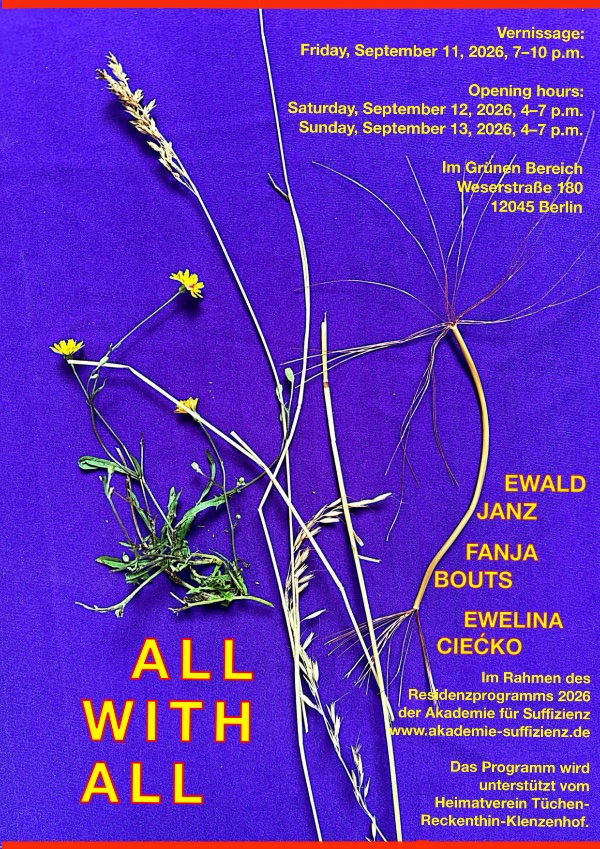
Im August 2026, Ewelina Ciećko, Fanja Bouts und Ewald Janz haben sich mit dem Thema ‚Alles hängt mit Allem zusammen‘ auseinander im Rahmen des 3-wöchigen Künstlerprogramms in der Akademie für Suffizienz in Reckenthin in Brandenburg. Ab Freitag, den 11. September, zeigen die drei Künstler die dort entstandenen Arbeiten nun hier Im Grünen Bereich in Berlin.
Ewelina Ciećko verwandelt Elektrokabel in eine Form, die lebenden Zellen ähnelt, und stellt die Frage, ob moderne Menschen sich ausreichend um ihr Gehirn kümmern. Sie untersucht, wie wir mit globalen Systemen verbunden sind, die wir derweil nicht wahrnehmen.
In der Arbeit von Fanja Bouts sitzen Figuren in einem Miniaturtheater fest und erzählen uns eine Geschichte von sich wandelnden Landschaften, von Böden in der Dürre und von Mikroorganismen. Sie fragen, ob Pflanzen als Kraftstoff ein Weg in die Zukunft sind.
Ewald Janz zeichnet Krähen, Wölfe und Schafe, arbeitet mit Materialen aus der Umgebung von Reckenthin und setzt sich dabei mit Fragen nach Zivilisation und Isolation auseinander.
Bezugnehmend auf die Gaia-Hypothese, die die Erde als systemische Gesamtheit betrachtet und die insbesondere von Bruno Latour in den Nachhaltigkeitsdiskurs getragen wurde, wollen wir zur Beschäftigung mit Zusammenhängen einladen.
English
In August 2026, Ewelina Ciećko, Fanja Bouts, and Ewald Janz explored the theme “All With All” as part of their three-week artist residency program at the Academy for Sufficiency in Reckenthin in Brandenburg. Starting Friday, September 11, the three artists will be exhibiting the works they created there here at Im Grünen Bereich in Berlin.
Ewelina Ciećko transforms electrical cables into a form that resembles living cells and asks whether modern people take proper care of their brains. She explores how we are connected to global systems that we are currently unaware of.
In Fanja Bouts’ work, figures are trapped in a miniature theater and tell us a story of changing landscapes, parched soil, and microorganisms. They ask whether plants as fuel are a path to the future.
Ewald Janz draws crows, wolves, and sheep; he works with materials from the Reckenthin area and explores questions of civilization and isolation.Drawing on the Gaia hypothesis—which views the Earth as a systemic whole and was brought into the sustainability discourse in particular by Bruno Latour—we invite you to explore these interconnections.